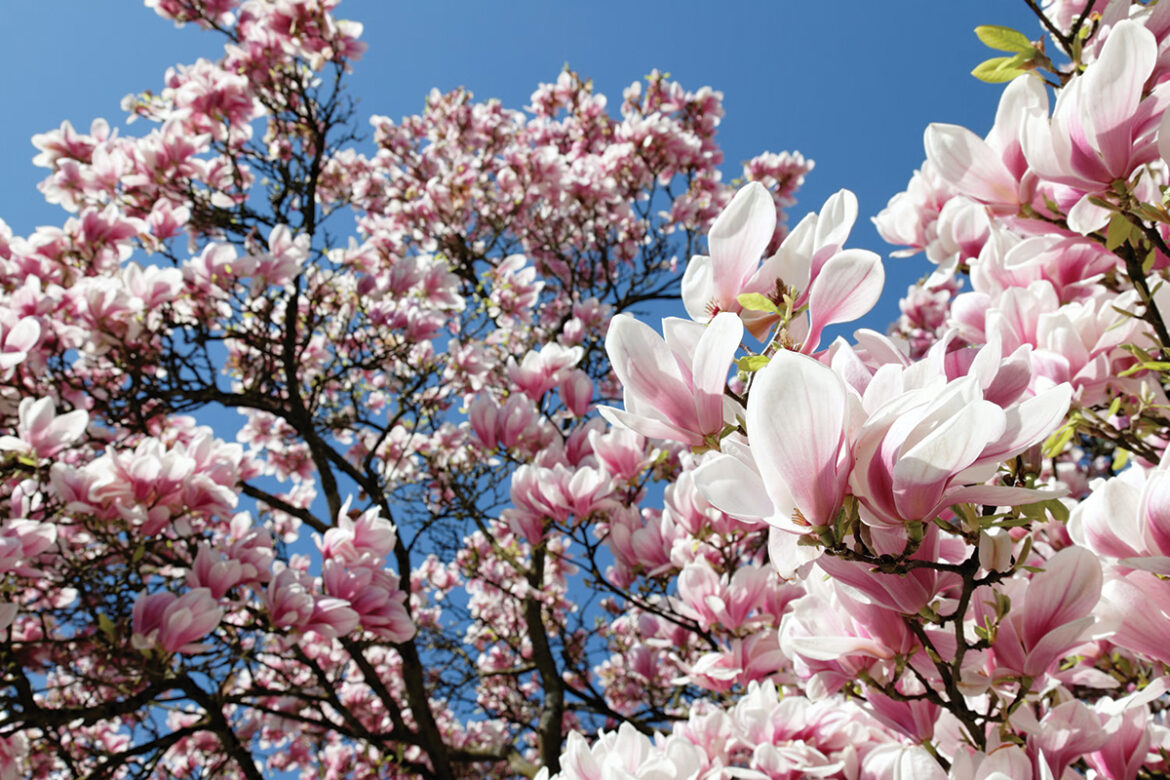
Nothing says “Southern” like gorgeous magnolias with their elegant and perfumed flowers. In fact, the Magnolia is the State Flower of Mississippi and Louisiana. There is something about magnolias that say “home” to me living in the Deep South. The good news is that you can plant magnolias in early spring for blooming throughout the spring and summer months. These trees are generally slow-growing as some seedlings can take 10 years after planting before they come into bloom.
Certain varieties, such as the Saucer Magnolia and Royal Star Magnolia, are known for their early spring blooms that can begin in February depending on the climate. Try to plant magnolias after the last frost choosing later-blooming varieties for your garden if possible. Always check with your local nursery for details. These early blooms will appear on the bare branches of the tree before the foliage even emerges.
Another early flowering magnolia includes the Yulan Magnolia. This beautiful tree is revered by gardeners for its alabaster white flowers and graceful tree form. Outstanding cultivars include Pink Goblet, Jon Jon, Sayonara, Winelight, Full Eclipse, and Darrell Dean. The variety called Southern Magnolia is good for planting at the beach as it can stand up to some salty sea breezes. The Sweet Bay variety tolerates wet soil.
Look for these and other outstanding magnolias at a local nursery or garden center. Although other varieties are not yet grown as widely as the Saucer Magnolias, they are increasing in popularity and are becoming more available.
Remember to plant your magnolia tree at least 50 feet away from your home to give the tree plenty of room to spread out as it matures. Magnolia trees’ root systems can grow super wide—up to 40 feet.
Magnolias thrive in full sun or partial shade with regular water. In warmer or dry climates, they appreciate some shade in the afternoon. Once they are established, magnolias can be fairly drought-tolerant. Remember though—if it’s really hot outside, you may need to water more frequently. Mulching around the base of the tree, but not near the trunk, will help keep water in. Check the leaves on the tree; they will begin to droop if you overwater.
Magnolias like to be watered 2-3 times a week at first and then once a week is fine. Magnolias prefer warm and humid climates. They do not usually have disease or pest problems, which makes them easy to grow! The best time to propagate a magnolia is in the summer after its buds have set with cuttings from young growth.
Follow these steps to properly propagate your magnolia tree:
- Use a sharp knife to cut a 6-inch piece from the tip of the branch, cutting above a node. Immediately place the cutting in water. Remove the lower leaves, keeping a few upper leaves intact.
- Dip the stem into a hormone rooting solution and plant the cutting into a 10- to 12-inch pot filled with moist, well-drained rooting medium.
- Place the pot in a sunny location, cover it with plastic, and keep moist until the cutting develops a system of roots.
To grow a magnolia tree from seed, follow these steps:
- Collect seeds from fallen cones during the fall. Let the cones dry and open them to collect the seeds.
- Soak the seeds in warm water for one to two days to soften the seed coating.
- Remove the seeds from the water and dry them to remove the coating.
- Pack the seeds with moist peat moss in a plastic bag and refrigerate them during the winter.
When outdoor temperatures reach 70 degrees, plant the seeds in the desired location in your yard. Mulch the seedlings well and protect them during the first few winters.
For any magnolia, be sure to pick your planting site carefully as all types are hard to move once established. The best soil for magnolias is fairly rich, well-drained, and neutral to slightly acidic soil.
Magnolias never look their best when crowded. Larger types of magnolias are most attractive standing alone against a background that will display their flowers at bloom time and show off their strongly-patterned, usually gray limbs and big, fuzzy flower buds in winter. Small magnolias show up well in large flower or shrub borders and make choice ornaments too. Most magnolias are excellent lawn trees; try to provide a good-sized grass-free area around the trunk, and don’t plant anything under the tree.
You can also plant magnolias in container gardens. When selecting a magnolia tree for your container garden, it’s crucial to choose a variety that is well-suited to your environment. The Kay Parris variety, with its dense and bush-like growth, is an excellent choice for container gardening. The beautiful blooms add a touch of sophistication to any space.
Another suitable option is the Little Gem magnolia variety, which has a compact growth habit and abundant flowers. Other magnolias can be grown in a container but it just might outgrow your container a little more quickly.
I hope you find a beautiful magnolia variety that fits into your garden perfectly, and whether it is a lawn magnolia or a container magnolia, I hope it says “home” to you in our beloved South.
Happy Spring and Happy Gardening!
Gaye Winter, Ph.D., teaches English at Mississippi Gulf Coast Community College and is currently serving as President of the Biloxi Garden Club. Reach her at
gaye.winter@mgccc.edu.