
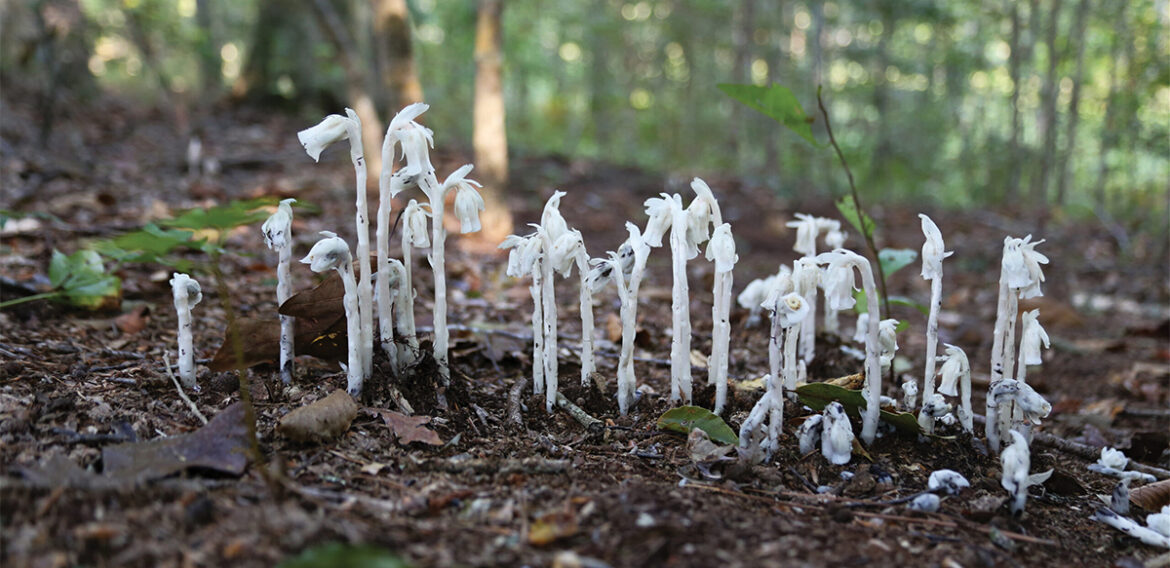
Since Halloween is in October, I thought it would be fun to discuss two types of “ghost” plants. A ghost plant can refer to a safe succulent (AKA Mother-of-Pearl Plant) or the Ghost Pipe (Corpse Plant), which is a wild forest plant that looks like a mushroom and contains compounds that can be poisonous in large quantities.
Succulent Ghost Plant
This succulent is easy to grow as well as maintain and propagate. It is non-toxic. These ornamental succulents feature a gray white color that changes depending on the amount of sunlight provided for them.
These succulents like the following:
- Full or partial sunlight in a cool area
- Good potting soil exclusively for succulents
- Water sparingly at soil level
These succulents should be planted with good drainage in mind. You might want to plant them in raised beds if your area receives a lot of rainfall. These make great container plants too. Whether these succulents are grown in raised beds or containers, spacing them away from each other and away from other plants will increase air circulation. This will keep plants healthy.
Ghost plants are slow-growing and generally don’t need frequent repotting. Remember to keep the ghost plant at the container’s edge in mixed plantings so it won’t get lost behind taller specimens. The pale whitish-gray leaves of ghost plants contrast pleasingly with purple-leafed plants.
Water outdoor plants once weekly if dry, and water indoor plants every other week.
Types of Ghost Plant Succulents:
You can identify a ghost plant from other succulents by its star-shaped flowers and pale color caused by a powdery-looking wax coating on its foliage.
- Bronze: Has reddish-bronze foliage and grows 6 inches tall
- California Sunset: Grows unique orange-pink leaves
- Douglas Huth: Has stunning pink to blue leaves and pink flowers bloom in spring
- Fred Ives: Has bronze to blue-green leaves with pale yellow flowers
- Tibutans: Grows especially thick leaves with pink or apricot tips in cooler weather
The ghost plant is easy to propagate. A healthy leaf that falls might even immediately root if conditions are right. To achieve full-sized plants, you might want to clip off and root one of the many offset “pups” at the end of the stems that grows from the parent rosette.
Blooming Ghost Plants
Most ghost plants bloom at random times indoors, but outdoors, flowers usually appear in spring. After blooms fade, be sure and cut off the faded flowers so the energy is redirected back to the plant. You can cut the stems off of the plant and harvest the seeds.
Even though the Succulent Ghost Plant is easy to grow, watch out for shriveling leaves (needs more water), or dropping leaves (root rot or lack of sunlight).
Wild Ghost Plant/Ghost Pipe/Corpse Plant
The Ghost Pipe Plant can be found on shaded, dark forest floors in Asia and North and South America. This ghost plant does not contain chlorophyll, which explains its white color and inability to obtain energy from sunlight. Since this rare forest plant does not have chlorophyll, it feeds off underground fungi. It is called a parasitic plant because it steals nutrients from a host tree. Usually, the relationship between a fungus and tree is beneficial as they “trade” nutrients, but the ghost plant does not trade any nutrients with its host.
It is interesting that Ghost Pipes propagate by being pollinated by bees, which collect nectar from the ghost plants’ flowers, and then, distribute their seeds.
The Ghost Pipe is mildly toxic and poisonous if eaten in large quantities. These plants are very rare and fragile. Foragers generally do not pick them or mess with them in any way in order to protect the local population. They are difficult to grow or transplant outside the deep forest. If the plant is deprived of its source of nutrients, it will quickly wither and turn black.
I hope you found this article on “ghosts” interesting! Happy Halloween and happy gardening!
Gaye Winter, Ph.D., teaches English at Mississippi Gulf Coast Community College and is currently serving as President and Historian of the Biloxi Garden Club. Reach her at gaye.winter@mgccc.edu.