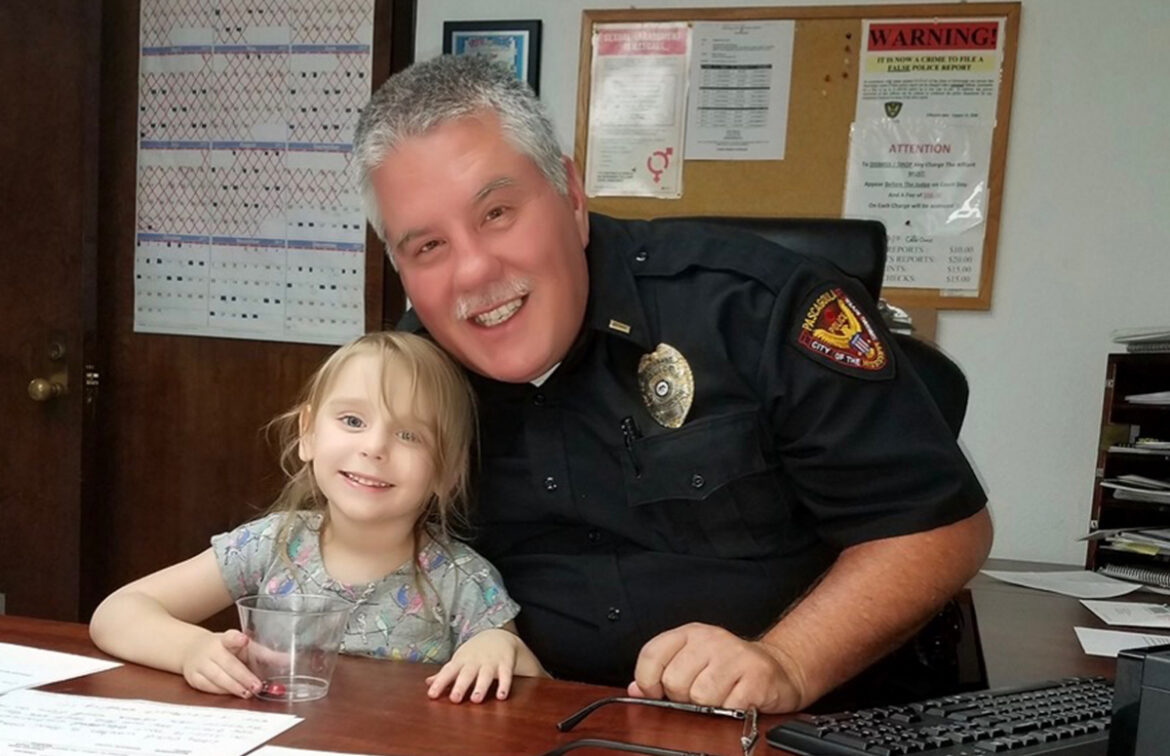
After nearly four decades in law enforcement, newly retired Pascagoula Police Lt. Darren Versiga admits there is one thing he may never fully walk away from—the cold cases. “The day I die is the day I’ll stop looking into cold cases,” Versiga said.
For most of his career, Versiga carried the kind of work many people spend their lives trying not to think about—murders, drugs, forgotten cases, and unidentified remains tied to some of the Gulf Coast’s darkest moments.
Versiga began his career as a reserve officer in 1988 before becoming a full-time Pascagoula police officer in 1992. Over the years, he worked narcotics during the height of the crack cocaine epidemic, served with the district attorney’s office, operated a private investigation business, and eventually returned to the Pascagoula Police Department in 2009.
Along the way, he witnessed both crime and investigations evolve dramatically. “When crack cocaine hit this area, it devastated families,” he said. “We saw things no one ever wanted to see.”
Some of the Coast’s most memorable criminal cases passed through his career, including homicides, child abductions, and eventually one of the nation’s most prolific serial killer investigations.
Versiga was extensively involved in efforts linking serial killer Samuel Little to victims in Mississippi. Little, who confessed to 93 murders across the country spanning from the 1970s through 2005, was ultimately connected to nine Mississippi victims—many of whom were initially overlooked because of addiction, prostitution, or assumptions surrounding their deaths.
“Some of these cases were ruled overdoses and were actually strangulations,” Versiga explained. “But Samuel Little remembered them—all. In great detail. Details no one else would have known.”
Versiga noted that Little exhibited a chilling lack of remorse for the people he killed, often speaking about them as if their lives held no significance.
In 2018, the serial killer confessed to murdering Melinda LaPree, a 24-year-old Pascagoula woman whose body was discovered near a Pascagoula cemetery in 1982. He was also linked to the death of Clara Birdlong, whose remains were identified through DNA testing in 2021 after decades as “Escatawpa Jane Doe.”
For Versiga, the investigation highlighted both the tragedy of overlooked victims and the power of evolving forensic technology to finally return names—and answers—to families after decades of uncertainty. And by the time Versiga met Little, the serial killer was aging and physically weakened. “He was a feeble old man,” Versiga said. “But the evilness was still there. You could see it.”
What stayed with Versiga most was Little’s complete lack of remorse for the victims he targeted. Little died in prison in 2020. He was 80.
But despite the notoriety surrounding cases like Little’s, Versiga said some of the most meaningful work of his career came through advances in DNA technology and efforts to identify previously unknown victims.
Over the years, investigators were able to revisit skeletal remains tied to old cold cases and finally reconnect victims with surviving family members. “Giving people their names back and taking them home to their families, that’s probably one of the best things I’ve ever been part of,” he said.
Versiga also witnessed firsthand how rapidly technology changed modern investigations.
In the late 1990s, he worked a case involving a brutal rape in which DNA evidence ultimately exonerated a suspect who had already spent months in jail.
“At that time, DNA was still in its infancy and now we only need 12 skin cells for a DNA profile,” he said, adding he believes countless cold cases once considered unsolvable may eventually be reopened through newer technology and more advanced testing methods.
But after decades spent pursuing answers, Versiga said law enforcement work also forced him to wrestle with difficult questions about justice, punishment, and humanity. And he holds onto moments when former criminals approached him years later to thank him for arresting them. “You don’t get that a lot,” he said. “But every now and then someone comes up and says, ‘You saved my life.’”
Even in retirement, Versiga does not plan to leave investigations behind fully. He recently reopened his private investigations business with his son and accepted a position investigating within a hospital system. He also expects cold case work to remain part of his life in one way or another.
For him, the job was never about recognition. “It was always for the people of Pascagoula,” he said.
And while his final day with the Flagship City’s Police Department officially arrived June 30, some files, he admitted, are never really closed.